The trip in numbers
- Route
- Yushu → Derge → Ganzi → Danba → Chengdu
- Days
- 7, counting the day I drove up alone
- Season
- Late December — frozen lakes, empty sites, short days
- Best light
- 9:30–11:00 and 15:30–17:00; dark by 18:30
- Pace
- Fast. One 8:00 start; two one-night stops I'd now give more time
- Where you sleep
- Yushu ×2 · Derge ×2 · Ganzi (Gesar City) · Zhonglu, Danba
The route, leg by leg
- YushuStart · Day 1~3,700 m 370 km · 5–6 h
- DergeNights 2–3 150 km · 3.5 h
- KathokDay 4 95 km · 2.5 h
- Yilun Latso (pass)Day 4~4,040 m 98 km · 1.5–2 h
- GanziNight 4~3,400 m 100 km · 1.5 h
- DaofuDay 5~3,000 m 150 km · 3 h
- Zhonglu, DanbaNight 5 360 km · 6 h
- ChengduFinish · Day 6
Approximate driving distance and time from one stop to the next (read top to bottom), not counting time spent at them.
Quick answer: this is the Kham half of my Chengdu–Yushu route run in reverse, and it works in winter. The two things to get right are both front-loaded: arrive in Yushu a day before your guests (or a day before you plan anything), and check the state of the G317 around Barkam before you choose how to come home — a landslide took the Hongqi Bridge out of service in November 2025 and the detour added half a day.
I ran this trip in late December 2025 with three guests who flew into Yushu. For me it started a day earlier, with a fast empty run up from Chengdu — Aba, Jigzhi, Golog, Dari, Maduo, Qingshuihe — essentially Route 3's first half and Route 2's last half stitched together at speed. Then the guests landed, and the real trip began.
At a glance
| Day | Where you sleep | The point of the day |
|---|---|---|
| 0 | Yushu | Drive up alone, eat well, rest — the altitude day |
| 1 | Yushu | Guests land in the afternoon; the one must-see is the mani stone city |
| 2 | Derge | Leave at 8:00, cross into Sichuan, the Derge printing house after lunch |
| 3 | Derge | Dzogchen monastery under snow peaks, and the Sichuan–Tibet border |
| 4 | Ganzi | Kathok, the S458 red-dirt road past Yilun Latso, hot-spring hotel |
| 5 | Zhonglu, Danba | Bridge-collapse detour: Luhuo, Daofu, and a wild hot spring under Yala |
| 6 | home | Zhonglu → a Hogwarts-looking bookstore in Dujiangyan → Chengdu |
Day 0 — The day before: why I always arrive in Yushu a day early
I drove up from Chengdu on my own on December 23, hard and fast, because the guests were landing the next afternoon and somebody has to be there first. I didn't stop to photograph anything, and I won't pretend the drive was the point. The point is what the extra day buys you: a night's sleep at altitude before anyone has to enjoy themselves.
Dinner that night was the best kind of Yushu find: Lhasa Sangqu Teahouse , the Xihang branch. It serves Tibetan food, the room is full of local people rather than travellers, prices are gentle, and the food is genuinely good. If you want the other end of the scale, Yushu Reception Hall is a handsome restaurant with a beautiful setting, and the cooking holds up. Between the two of them you're covered for a night and a day.
Where to sleep: I'm not going to recommend a hotel. Yushu is a city — it has plenty of rooms at every level, the listings on Ctrip are current, and nothing about this route depends on the hotel you pick. Book whatever suits your budget and spend the energy elsewhere.
One more thing deserves its own paragraph: in December, Yushu sits around −15°C even in the daytime. The city has heating by default, so you as a person are fine — it's the car you should think about. At temperatures that low, a car can slide even on a road with no ice on it: the tyres go hard and the grip fades. Fit winter tyres before you come, and drive slower than the road seems to ask for.
One more thing deserves its own paragraph: in December, Yushu sits around −15°C even in the daytime. The city has heating by default, so you as a person are fine — it's the car you should think about. At temperatures that low, a car can slide even on a road with no ice on it: the tyres go hard and the grip fades. Fit winter tyres before you come, and drive slower than the road seems to ask for.
One more thing deserves its own paragraph: in December, Yushu sits around −15°C even in the daytime. The city has heating by default, so you as a person are fine — it's the car you should think about. At temperatures that low, a car can slide even on a road with no ice on it: the tyres go hard and the grip fades. Fit winter tyres before you come, and drive slower than the road seems to ask for.
Day 1 — Guests land in the afternoon; one stop that matters
Here is the thing I want every Yushu first-timer to read twice. The city sits at about 3,700 m, and you arrive by plane, from sea level, in forty minutes. One of my three guests spent his first day nauseous — nothing dramatic, just the body objecting to the altitude — and he was the fittest of the three. Flying in and planning a full afternoon is how you ruin Day 2. Land, walk slowly, drink water, eat dinner, sleep. If you have exactly one thing in you, make it this one:
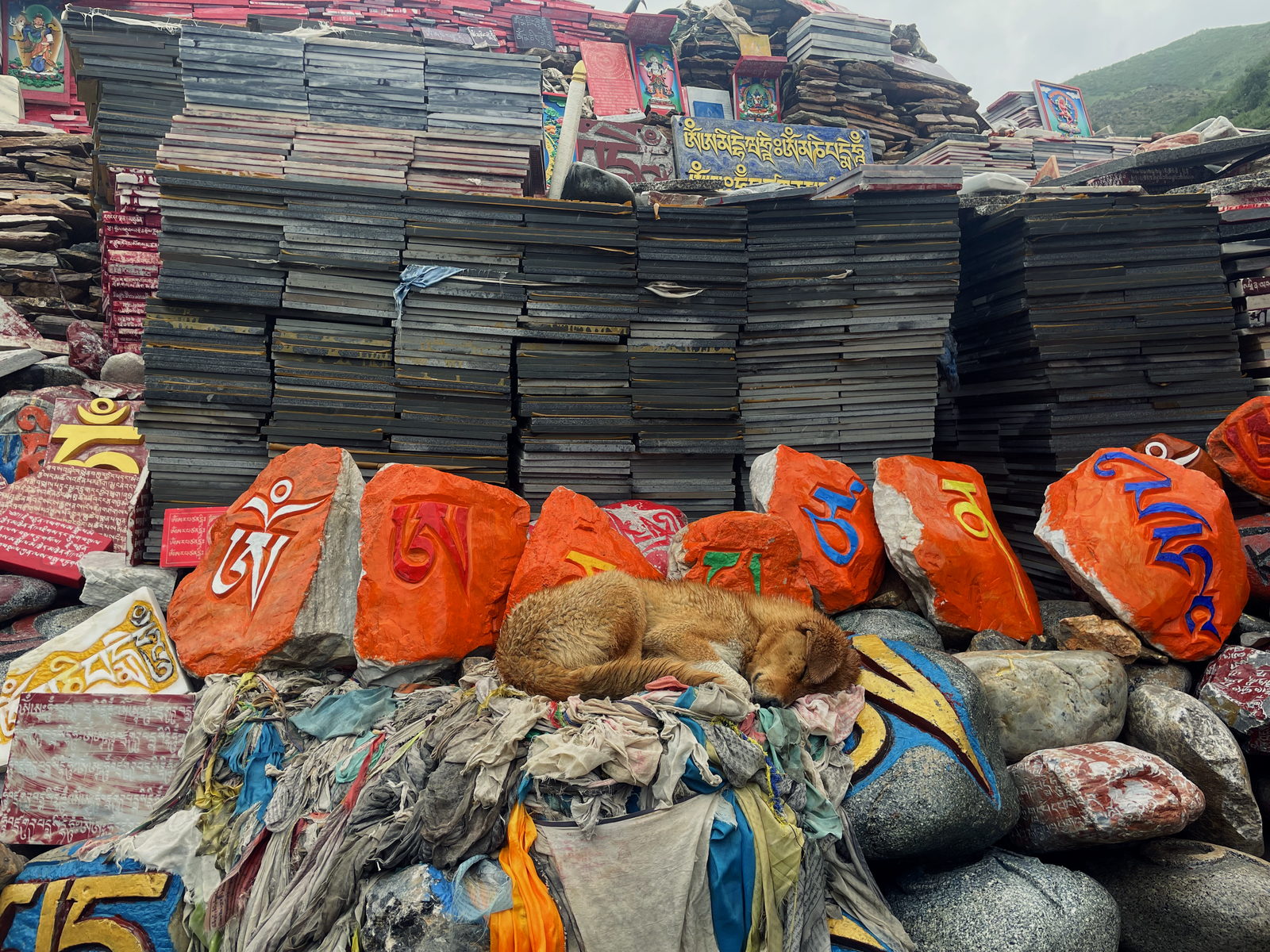
Gyanak Mani , a few kilometres east of the centre. I wrote about walking it in my other route; here is the rest of what's worth knowing. A monk called the first Gyanak Lama began the pile in 1715; local people have been adding carved stones ever since, to the point that the count is estimated past 2.5 billion stones — a Guinness World Record since 2002 as the largest mani stone pile in the world. The 2010 Yushu earthquake broke parts of it; what you see now has been carefully rebuilt, and it is free, open all day, and alive: craftsmen carve new stones at the edge of the site, and pilgrims keep adding them. Walk clockwise with everyone else.
Day 2 — Yushu to Derge: eight sharp, printing after lunch
Depart at 8:00. The road runs south through Shiqu country, over the pass into Sichuan, and down into Derge — roughly 370 km and five to six hours with stops, which is why the early start matters: it puts you at a table for lunch, with the whole afternoon free for the best building in Kham.
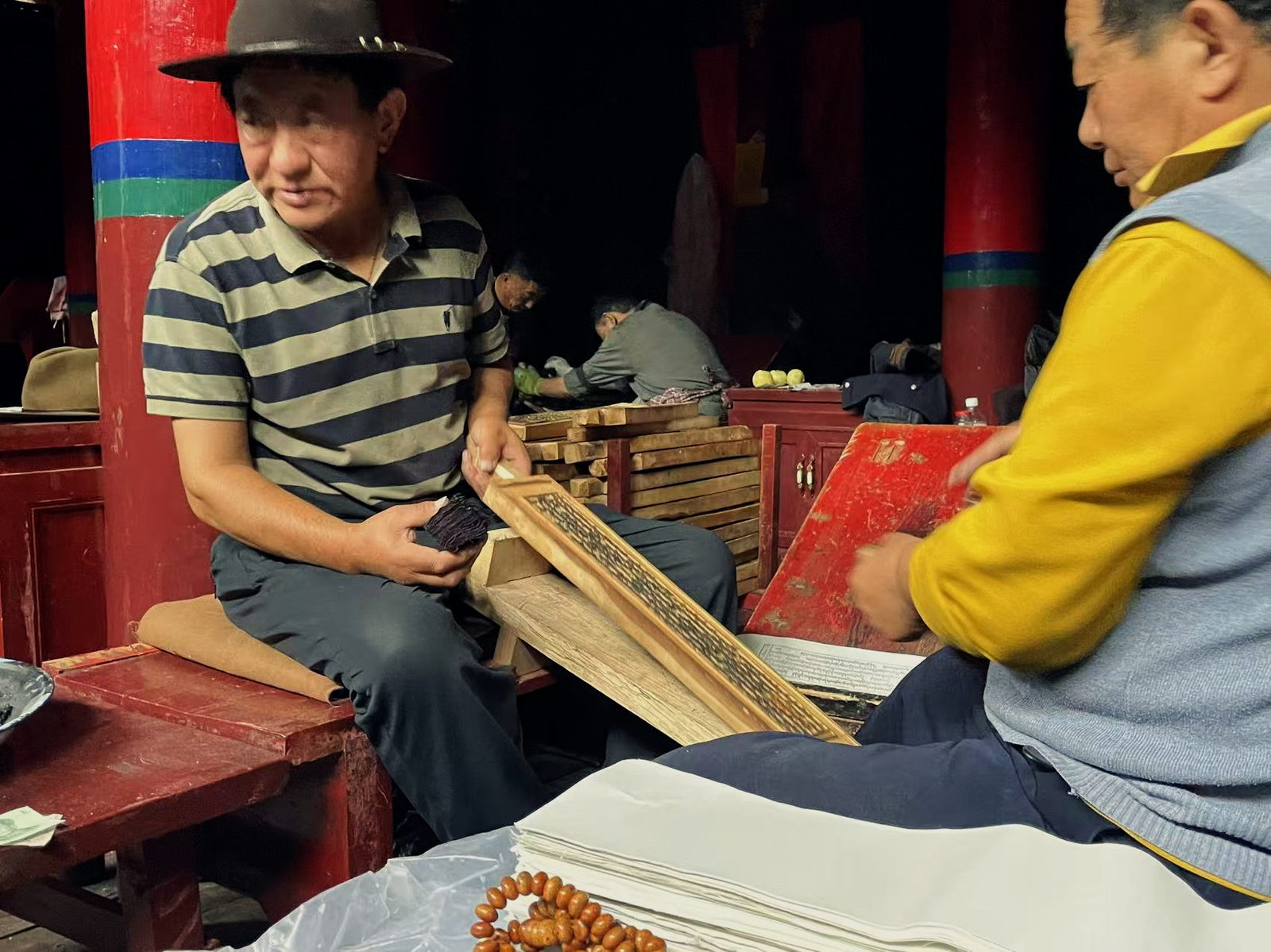
The Derge Parkhang — the Derge Printing House — is one of the three great printing houses of the Tibetan world, founded in 1729, and unlike the other two it still prints the old way in front of you: one sheet, one slab, one pull. Around 300,000 hand-cut woodblocks, including the most accurate editions of the Kangyur and Tengyur, and — the detail I find most interesting — the texts of five traditions of Tibetan Buddhism, not the usual four: Nyingma, Kagyu, Sakya, Gelug, and Bon. Give it two hours minimum. One more thing most visitors don't know: most of the workers here are local residents. Printing doesn't pay much — they take the job out of faith, which holds that contributing to the scriptures earns merit.
Day 3 — Dzogchen monastery, and the border
A there-and-back day, and worth it. South of Derge into Zhuqing town , where Dzogchen monastery sits in a valley under snow peaks — the kind of place where the whole valley is the monastery and it takes a moment to read the scale of it. You register at the gate; there is no ticket. Drive to the lowest car park and start there, and if your legs are willing, walk a little way up the hillside to see the retreat caves of the old masters.
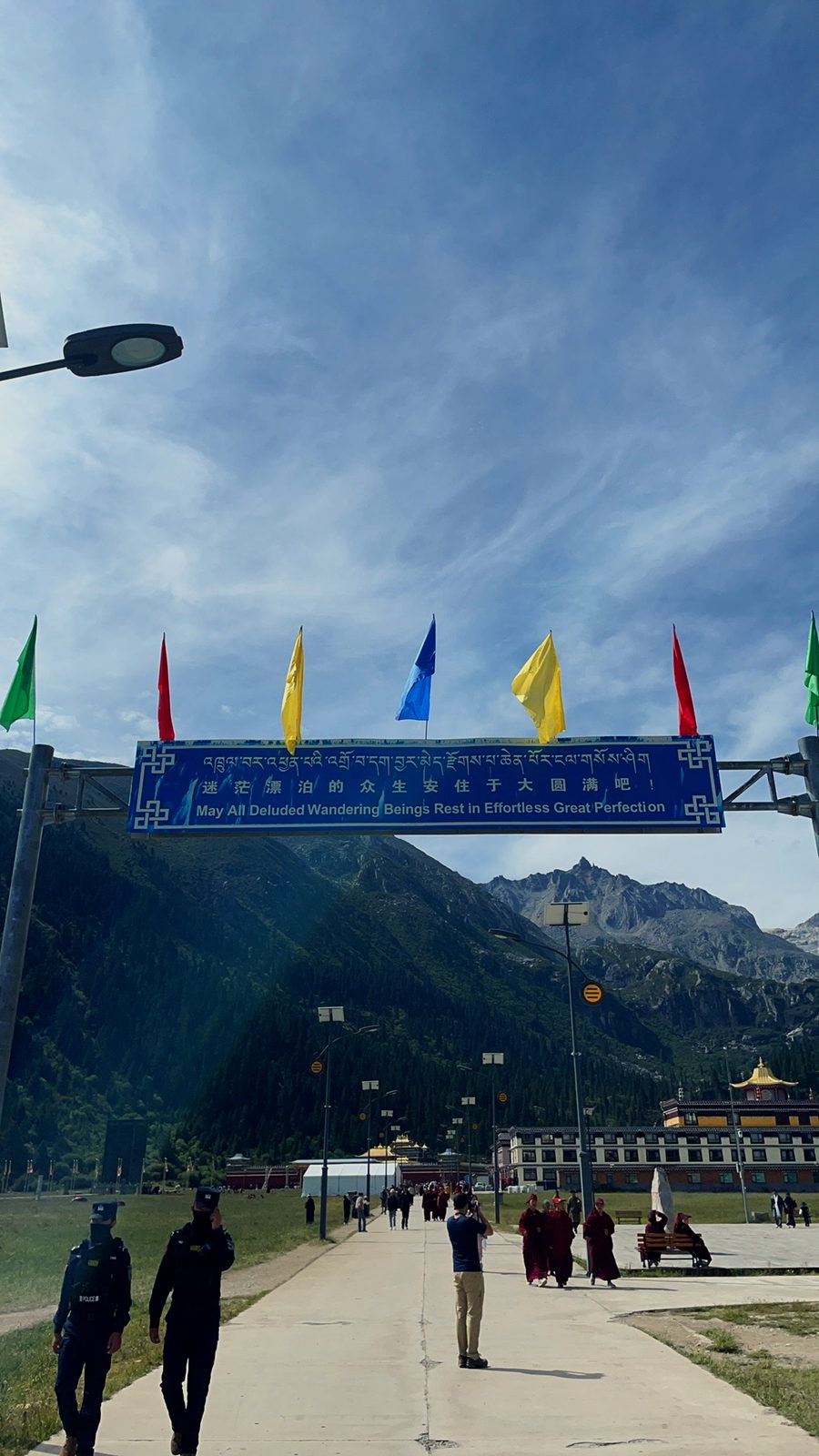
On the way back we also ran up to the Sichuan–Tibet border for the viewpoint: the Jinsha River valley, Tibet on the far bank. Without a special permit you can't cross — worth understanding before you assume the road simply continues — but the border itself, this time, was the destination.
Day 4 — Kathok, the red-dirt road, and the lake we didn't stop at
This is the biggest day, and the one I'd now cut in half if I ran it again. Morning: Kathok monastery , one of the mother monasteries of the Nyingma tradition, founded in the twelfth century and known as the "second Vajra Seat". It is remote even by the standards of this route — the visitors we met on the road up had almost all come from Lhasa by chartered car, and they were pilgrims, not tourists.
Then the road decision. The normal way to Ganzi goes back up the G317 through Manigango. Instead we took provincial road S458, which trades ease for scenery: narrower, steeper, more cliff, and in exchange you drive for an hour with red earth and snow mountains stacked on both sides of the road. I wouldn't drive it in the dark or in bad weather, but in daylight it is one of the best hours of driving in Ganzi.
S458 also passes Yilun Latso — the lake most maps still call Xinlu Hai — and this is the trip's honest regret: no time, no stop. What's there, from the record: a glacial lake at 4,040 m under the Chola (Que'er) Shan massif, its name meaning roughly "the sacred lake Zhumu fell in love with", after the queen of King Gesar in the epic; the "new road" name comes from the soldiers who built the highway here. By late September the lake freezes and stays frozen into late March — in December it was white. It sits 98 km from Ganzi town, which makes it an easy half-day from either end. Next time, I stop.
We also passed Tashi Chöling and the new Zhaxi temple in the Yulong valley — a retreat centre at about 4,000 m, rebuilt by the khenpo whose book Cidi Huakai (《次第花开》) is one of modern China's best-loved books on Buddhism. I had read it before this trip; only on the ground, with the white stupas and the prayer-flag slopes in front of me, did I understand how many stories sit behind that magnificent place.
Night: the Ruobrin hot-spring hotel in Gesar City on the edge of Ganzi town. Standalone little houses, real spring water pumped up from underground every day, and in the evening the themed town around it runs performances and street life — if you travel with people who like a bit of noise and spectacle after a day of silence, this is your stop.
Day 5 — The bridge that changed the plan: Ganzi → Daofu → Zhonglu
The plan on paper was simple: G317 east to Barkam, then the familiar road down to Danba. The plan met reality on November 11, 2025, when a landslide behind the Hongqi Bridge at Shuangjiangkou, near Barkam, dropped part of the bridge and the road behind it. The highway had been closed in time — nobody was hurt — but G317 stayed shut through December, and our route died with it.
So we went the other way: south from Ganzi through Luhuo and Daofu , then down into the Danba valleys. And here the trip got a bonus. Just below the Yala Snow Mountain viewpoint , at the foot of the mountain, there is a string of wild hot springs run by local families: ¥10 for a foot soak, ¥25 for a bath, ¥5 a hot-spring egg. Sitting in hot water, snow peaks overhead, in late December — it was the best hour of the trip and it cost less than a coffee in Chengdu.
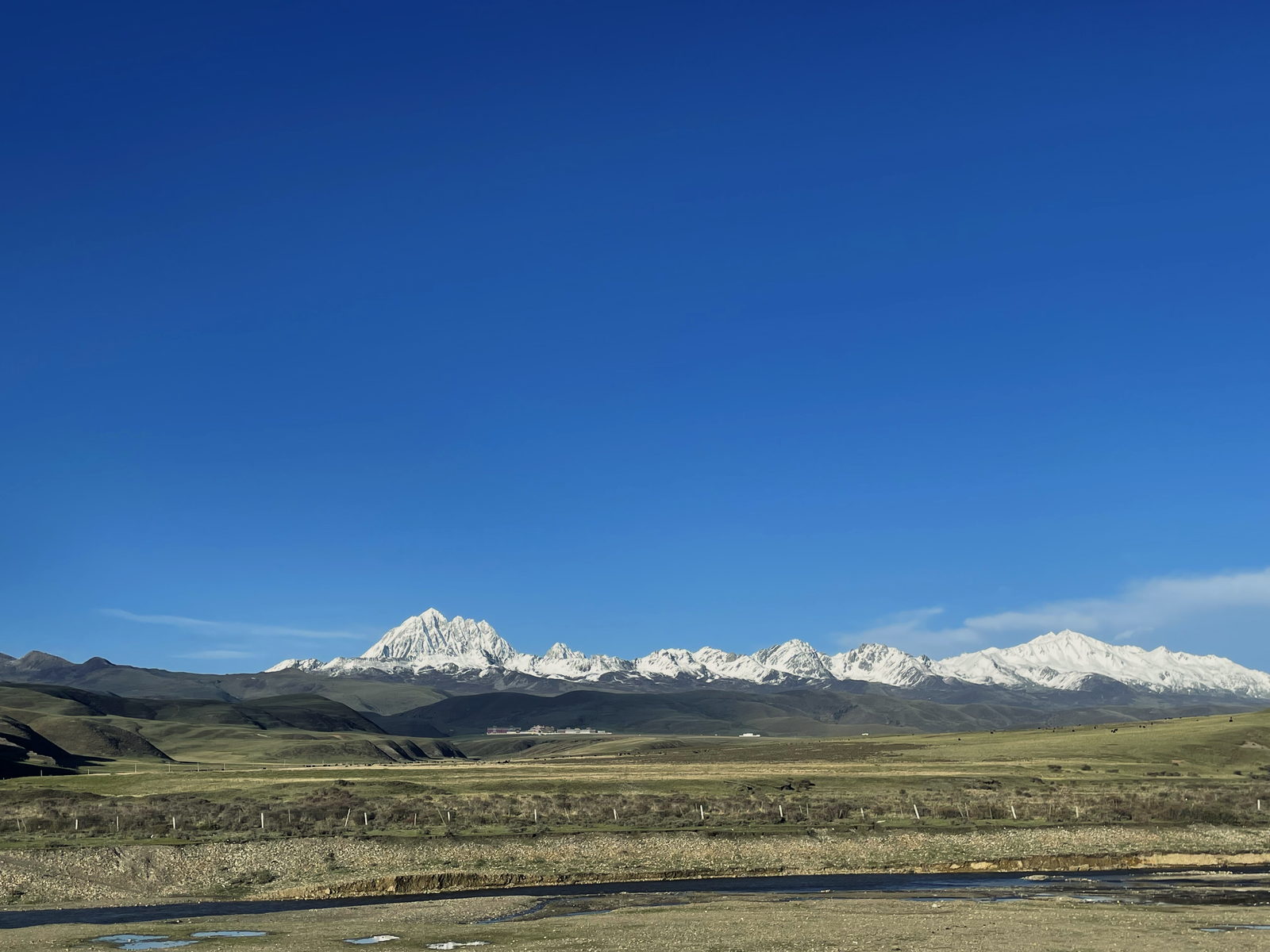
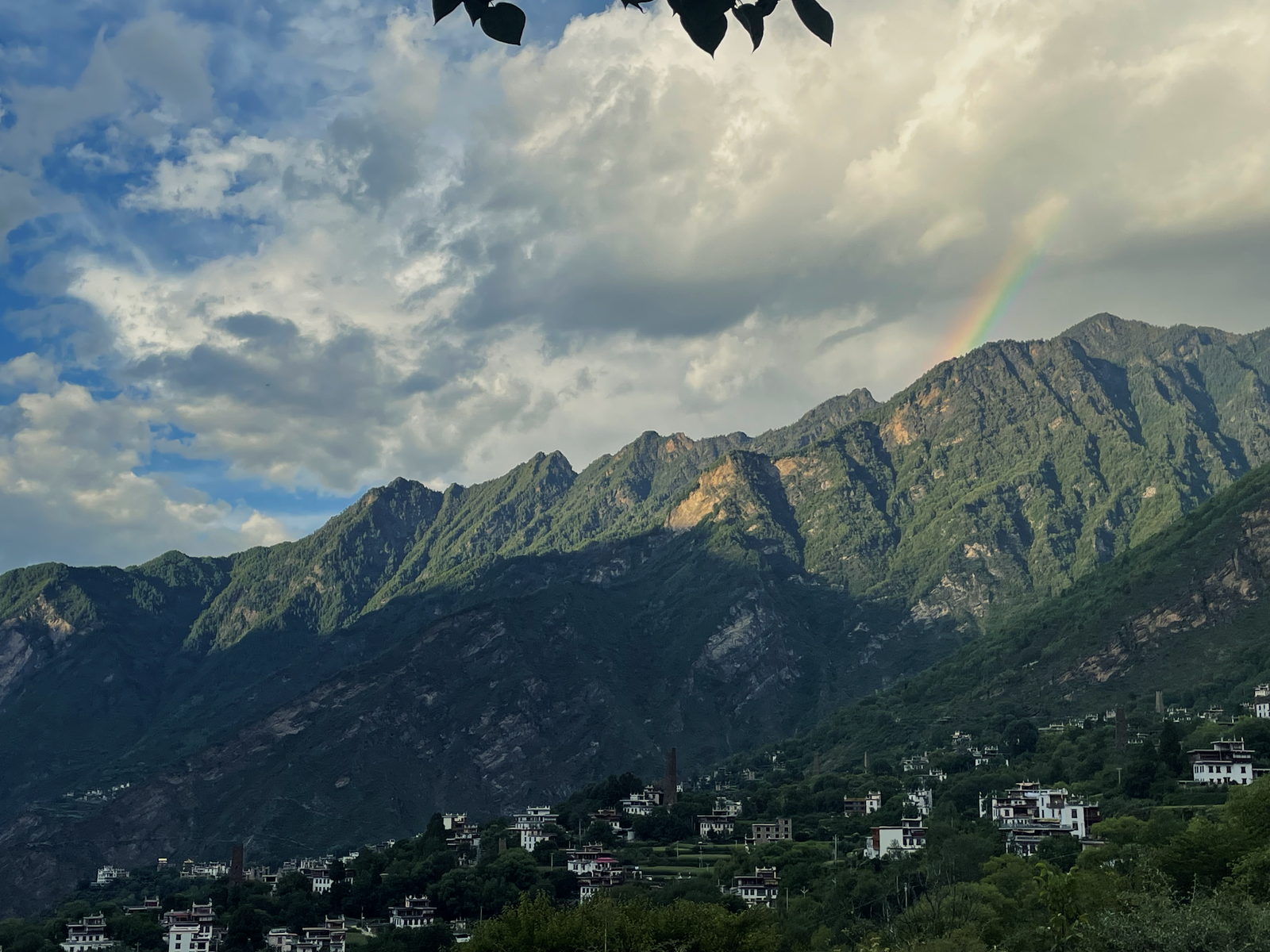
From there it is country I have written about in my five-day loop: down past Bamei into Danba, up the side valley to Zhonglu , the watchtower village on its terrace above the river. Winter empties it out. Sleep there — the towers want early light.
Day 6 — Zhonglu → Dujiangyan → Chengdu
Six hours of driving and one stop worth making, especially with foreign guests. In the Sunac Mall in Dujiangyan there is a branch of Zhongshuge , the bookstore chain whose designers build rooms that behave like optical illusions — mirror ceiling, black floor, ring after ring of bookshelves, a spiral staircase that photographs like a dreamscape. The Dujiangyan branch borrows its shapes from the ancient irrigation works: the book walls rise like the city's old flood walls. Every foreign guest I have taken there has said some version of the same thing: this looks like Hogwarts. Free entry, open 10:00–21:00, and honestly one of the best bad-weather stops in the region. Then the last hour into Chengdu, and the trip is over.
What I got wrong the first time
I ran this trip too fast. I knew it while it was happening: a there-and-back day to Dzogchen, a lake driven past without a stop, a monastery morning squeezed before a five-hour afternoon. Nothing on this route is far from everything else — that's the trap. If I ran it again: two nights in Ganzi instead of one, Yilun Latso in its own morning, and the hot-spring hour kept exactly as it was, because that one I got right.
Three things people get wrong here
One: flying into Yushu and planning for the same afternoon. The city is at 3,700 m; you arrive from sea level in under an hour. One in my group of three felt it badly. Arrive the day before, or land and do nothing.
Two: assuming G317 is open. The Hongqi Bridge collapse near Barkam closed the road in November 2025 with no warning for people who hadn't checked. Mountain highways in this region close for landslides, snow, and roadworks with very little notice; check the day before, and hold a detour in your head the way this trip needed one.
Three: treating S458 like a normal road. Between Kathok and Ganzi it is narrow, steep and cliffy. In daylight it is magnificent. In rain, snow or darkness it is none of those things. Plan the day so you're through it before the light goes — and in December the light goes early.
If you only have five days
Skip Day 0 entirely and fly in a day early anyway — that part is not optional. Then compress Day 3: drive Yushu → Zhuqing → Derge in one run with Dzogchen on the way, and give the recovered day to Yilun Latso and a second night in Ganzi. Keep the Zhonglu night; the watchtowers at dawn are worth more than any hour you save.
Questions people actually ask
Is it safe to drive this route in winter?
With checks, yes. The main roads were dry for us; the risks are ice on the high passes, the short December light, and closures like the Hongqi Bridge. Look at the road status the evening before each driving day.
Can foreign visitors enter the monasteries on this route?
Derge Parkhang, Dzogchen and Kathok all receive visitors; you register at Dzogchen's gate and there is no ticket. The Sichuan–Tibet border is where it stops — without a special permit you can't cross into Tibet, only look at it.
How bad is the altitude in Yushu, really?
Plan for it, and it's fine. Ignore it, and it costs you a day. One of three guests was nauseous on arrival day at 3,700 m. Nothing beats sleeping at altitude the night before your first real day.
Is the Hongqi Bridge open again?
It collapsed in November 2025 and stayed closed through our December trip; reopening was not scheduled when I last checked. Don't plan around an answer — plan the Daofu detour as a real option, not a fallback.
Is Yilun Latso worth a stop in winter?
It was frozen white when we drove past, and I regret not stopping, which is the only recommendation I can give first-hand. From the record: 4,040 m, frozen roughly late September to late March, 98 km from Ganzi.
Where does this route connect with your others?
It is the reverse of the second half of Chengdu–Yushu, and its first day runs over the same ground as the mountain half of the Xining–Chengdu route. Drive all three and you have seen the whole corridor.
Honest notes
The photographs on this page come from other journeys on the same roads, in other seasons — my December material is still being cut. The Hongqi Bridge facts come from official notices and the published investigation report; the Yilun Latso figures from local government sources. Driving times and distances in the route map are public-map estimates except the legs I have corrected from my own logs. Everything else is what happened.
Where to go next